
Water Softener vs. Whole-House Water Filter: Which Does Your Monmouth County Home Need?
Not sure if your Monmouth County home needs a water softener or a whole-house filter? Learn the key differences and why testing comes first.
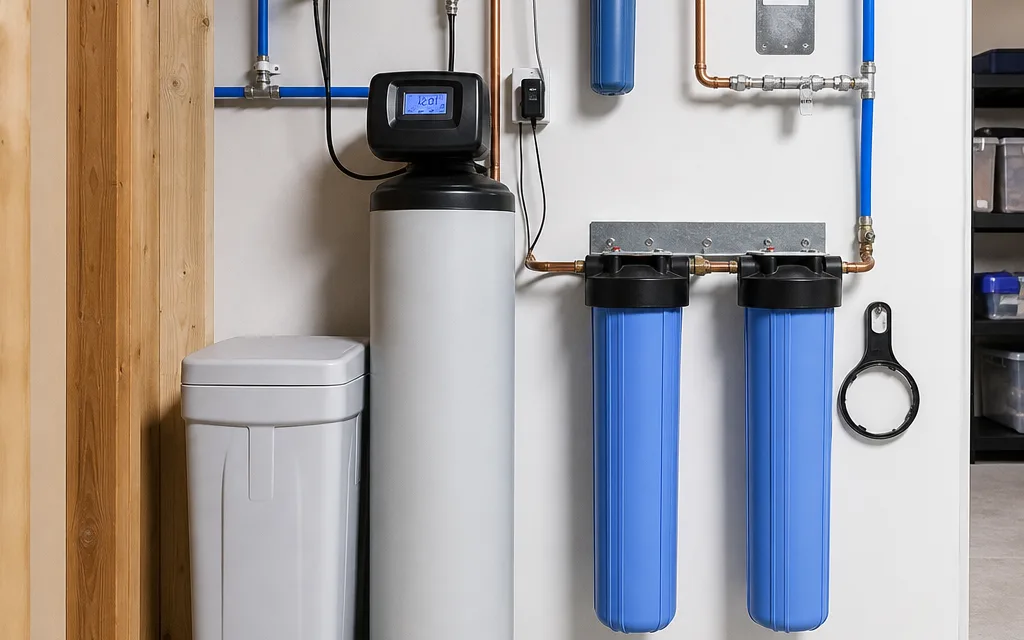
If your water leaves spots on glassware, feels slippery, or just does not taste right, it is natural to wonder whether a water softener or a whole-house filter is the fix. The two systems solve different problems. A softener addresses hardness and mineral scale, while a whole-house filter treats water quality concerns at every tap in the home. The most reliable way to know which one your Monmouth County home needs, or whether it needs both, is to start with a water test.
What Each System Actually Does
It helps to be clear about the job each system is built for before comparing them.
- Water softeners are designed to address calcium and magnesium hardness, the minerals that cause scale buildup, soap scum, and stiff laundry.
- Whole-house filters are designed to address water quality concerns across the home, such as sediment, taste, and odor, with the treatment media matched to what is actually in the water.
Because these systems are built for different categories of problems, "water treatment" is not a single interchangeable product. A softener will not necessarily resolve a taste or odor concern, and a filter will not necessarily soften hard water. In some homes, testing confirms both a hardness issue and a separate water-quality concern, which is when a combined approach can make sense.
Start With a Water Test, Not a Guess
Choosing equipment based on a neighbor's setup, a townwide assumption, taste alone, or whatever brand is most familiar can mismatch the equipment to your actual water. Best Pro Service tests for hardness, iron, sulfur, sediment, and bacteria, then provides written results and matches filtration, softening, or purification options to the findings. Testing first means the recommendation is based on your home's actual water conditions and source, not an assumption about what water in the area is generally like.
Water test results can point in a few directions:
- Hardness only, which points toward water softener installation.
- Water-quality concerns across the home, which points toward whole-house filtration.
- Both hardness and separate water-quality concerns, which may call for a combined approach since filtration and softening address different issues.
If you have not had your water tested recently, test your home's water before choosing a system so the decision is based on documented results.
What Goes Into Each System
Once testing points to a direction, selection and installation involve more than just picking a product off the shelf.
| Water Softener Installation | Whole-House Water Filtration |
|---|---|
| Hardness test | Water test |
| Grain-capacity sizing based on household water use | System sizing to the home |
| Bypass and drain plumbing | Point-of-entry installation at the main water line |
| Brine-tank setup | Sediment and carbon stages |
| Regeneration schedule | First filter change |
Softener capacity should reflect actual household water use, and whole-house filtration needs to be sized to the home and installed at the point where water enters, so both systems depend on more than matching a product to square footage alone.
Private Wells and Changing Conditions
Homes on private wells have a few extra reasons to test. The U.S. Environmental Protection Agency recommends retesting when conditions change, such as a shift in taste, odor, or color, after flooding, following well repairs, or after nearby land disturbance. New Jersey's Private Well Testing Act also requires untreated private-well water to be tested before many real estate transactions, with specific requirements that vary by county. If any of these apply to your home, a new test is a reasonable starting point even if you already have a treatment system in place.
Beyond Softening and Filtration
A water test does not always lead to only these two options. Best Pro Service also offers reverse osmosis, UV purification, and iron, sulfur, and odor removal, along with filter replacement and maintenance. These paths exist specifically because different water conditions call for different equipment, which is part of why testing before buying matters.
Frequently Asked Questions
Can a home need both a water softener and a whole-house filter?
Yes. When a water test identifies both hardness and a separate water-quality concern, a combined approach can make sense since the two systems address different issues.
What should a water test check before choosing a softener or filter?
A useful test checks hardness, iron, sulfur, sediment, and bacteria, with written results that can be matched to the right filtration, softening, or purification option.
Does a whole-house filter make water soft?
Not necessarily. A whole-house filter is built to address water-quality concerns like sediment, taste, and odor. Softening hardness is handled by a water softener.
Get Your Water Tested in Monmouth County
Before deciding between a water softener and a whole-house filter, let Best Pro Service test your water and walk you through what the results mean for your Morganville, Marlboro, or wider Monmouth County home. Call (732) 858-3616 to schedule, or if you prefer a water softener installation for hard-water scale or whole-house filtration at every tap, our team can help you choose the right fit once your results are in.